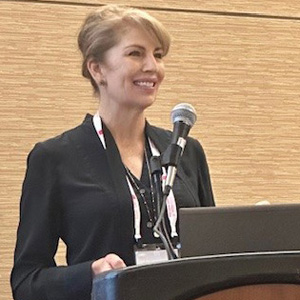

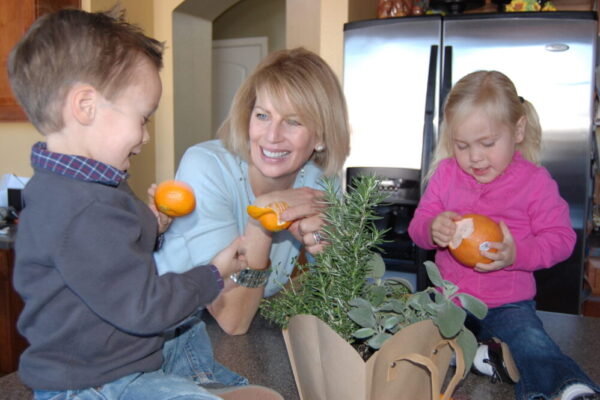
Melanie Potock, MA, CCC-SLP is a mom who once had a picky eater. She’s experienced first-hand the stress that parents feel when they are worried about their child’s nutritional health. Fast forward to today, and you’ll find Melanie blending her knowledge of feeding therapy with practical parenting strategies that help the entire family eat healthier. She’s an international speaker and author of six books, including co-authoring the award-winning Raising a Healthy Happy Eater. Whether you’re raising a child who seems to be on the path to loving all kinds of healthy foods (and you want to keep it that way) or if your child is stuck in the chicken nugget rut, “Coach Mel” is here to guide you.
Melanie Potock
Pediatric Feeding Expert and Author
Expert Feeding Help
for Professionals and Parents
Melanie Potock’s keynotes, courses, books & articles focus on raising kids to be healthy, happy eaters. From babies to toddlers to teens, “Coach Mel” is here to help.
Raising a Healthy Happy Eater Isn’t Always Easy
Get Expert Advice on Feeding Babies, Toddlers & School Age Kids,
Including Extreme Picky Eaters
Upcoming Events & Courses
Babies
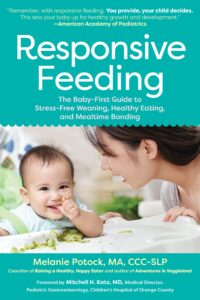
This book is designed to answer the most common questions about feeding babies and toddlers up to age three. It also debunks myths while offering practical tips on making mealtimes joyful and less stressful. It teaches a no-nonsense, straightforward approach to responsive feeding that’s focused on nurturing trust and communication between parent and child. Read more about Responsive Feeding here.
Toddlers & Preschoolers
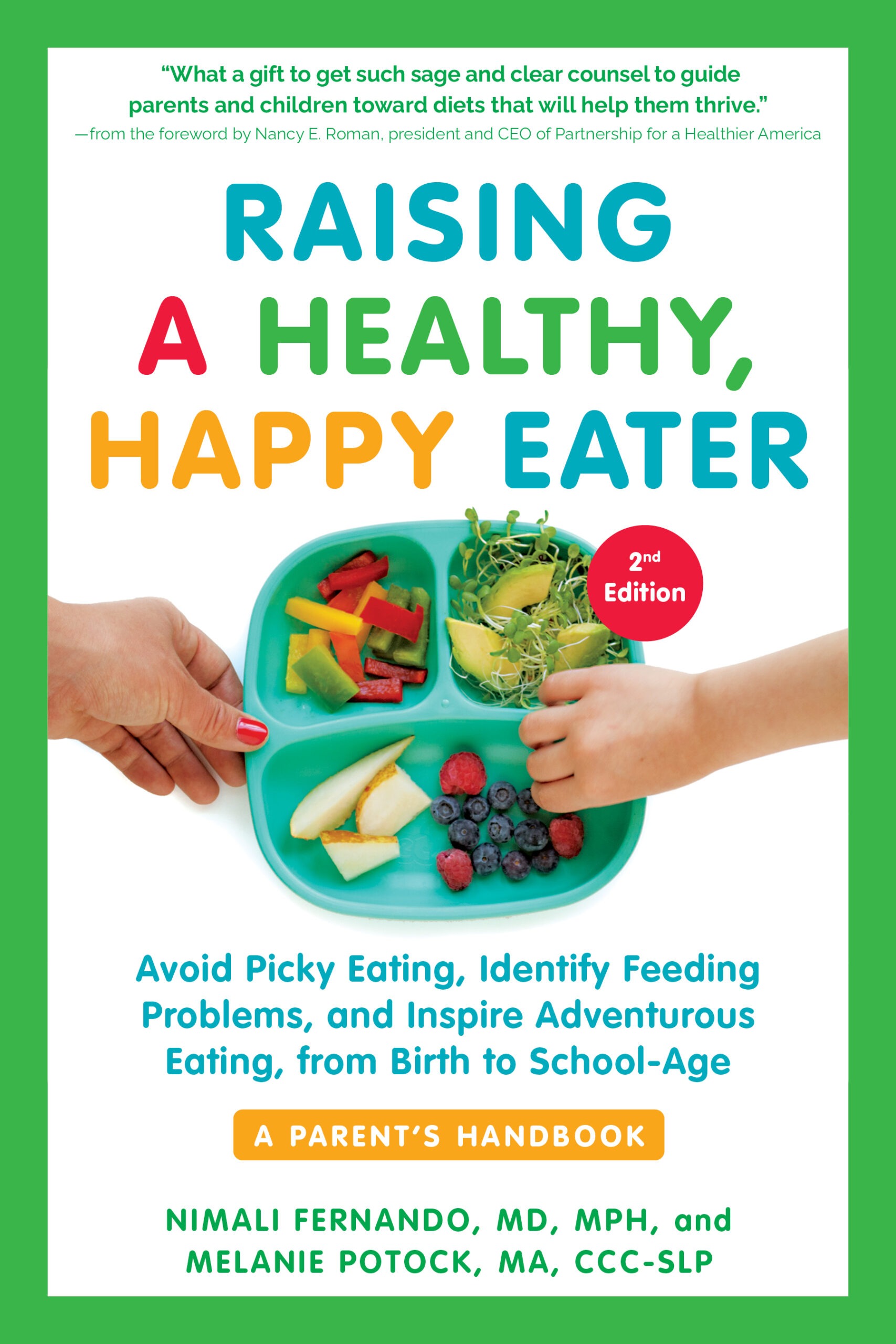
In her award-winning book, Raising a Healthy Happy Eater, Melanie and her co-author, pediatrician Dr. Yum, teach parents how to guide their children on the path to adventurous eating. Parents report that toddlers are the most challenging to feed, thanks to active little bodies and fleeting attention spans. Learn how to lay positive foundations for eating at 6 months of age, navigate the “terrific twos” and avoid picky eating in the preschool years! Get the brand new, updated 2nd edition. Read more about feeding young children here.
School Age
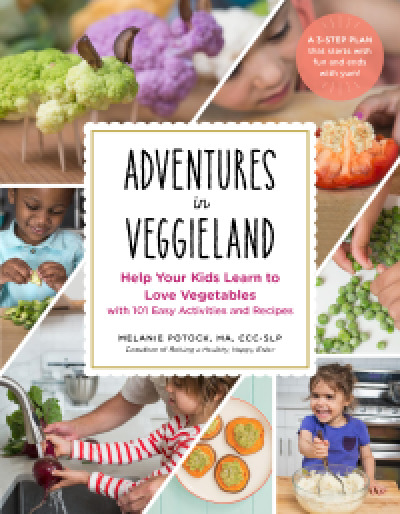
Kids can cook right along with their parents from an early age, but it’s especially important from preschool and into the elementary school years. What’s the number one food group that parents struggle with the most? Vegetables! The secret to helping kids love any kind of food is to follow Melanie’s Three E’s: Expose, Explore, Expand. You’ll learn how to use the Three E’s and create veggie-love in Melanie’s book, Adventures in Veggieland: Help Your Kids Learn to Love Vegetables with 100 Easy Activities and Recipes. Read more about feeding school-age kids here.
More fun!
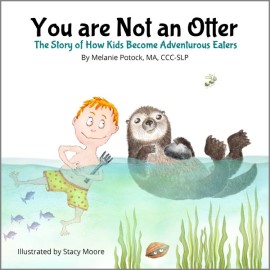
As a speech language pathologist, Melanie combined her love for language, little kids and food by writing a children’s book! You are Not an Otter: The Story of How Kids Become Adventurous Eaters is available on Kindle, in paperback, and in both English and Spanish. Don’t miss the parent tips in the back of the book! Learn about all of Mel’s books here.
👻 Before you fill that Halloween candy bowl, there are a few things I’d
leave OFF the shopping list.
Because some treats & trinkets that seem perfectly innocent can be a real
hazard for young children. And a couple on my list may surprise you. 👀
🎃 Here’s what I would NOT hand out:
🎈 LATEX BALLOONS
This is a big one. Latex balloons are a serious choking hazard, especially
for children age 8 and younger. If you want balloons, choose shiny
foil/Mylar instead.*
🟠 TINY STICKERS
They stick to little fingers, and young kids often use their mouths to try
to get them off. Small stickers can become a choking or aspiration hazard.
🍿 POPCORN & POPCORN BALLS
Popcorn is a choking hazard for young children, so save this treat for the
bigger kids.
🍬 HARD, ROUND OR VERY CHEWY CANDY
Think jawbreakers, hard candies, gum, caramels and similar treats that can
be difficult for little mouths to manage safely.
🍫 VERY HARD CHOCOLATE TREATS
For little ones, I’d choose chocolate that melts readily in the mouth and
skip varieties with hard nuts, candy pieces or other difficult-to-manage
add-ins.
And what about “allergy-safe” treats? 🩵
With so many possible food allergens beyond the Top 9, there isn’t one food
treat that’s guaranteed to be safe for every child.
So consider putting some NON-FOOD TREATS in that bowl too!
One year I handed out colorful little sticky-note pads with a pumpkin
sticker on top. 🎃🗒️
Guess what disappeared BEFORE the candy?
THE STICKY NOTES. 😂
Even the teenagers grabbed them!
Want some fun non-food Halloween treats that can still arrive before
Halloween?
🎃 Comment HALLOWEEN and I’ll send you my ideas!
And SHARE this with the person buying the Halloween treats this year. 👻
*Source: Nationwide Children’s Hospital, Choking Hazard Safety
Melanie ❤️
Melanie Potock, Halloween safety, Halloween treats for kids,
toddler choking hazards, safe Halloween treats, non-food Halloween treats,
Halloween candy safety, pediatric feeding specialist

🎃 What if one of the BEST things in your child’s Halloween bucket is
something that happened years before Trick-or-Treat night?
🥜 EARLY peanut introduction.
Research published last year in Pediatrics gave us something pretty
exciting to celebrate: Researchers found that diagnoses of peanut allergy in
young children declined significantly following the shift toward early
introduction of peanut.
In fact, when researchers compared children from before the guidelines with
those after the 2017 updated guidelines, the cumulative incidence of peanut
allergy dropped from 0.79% to 0.45%. That’s about a 43% decrease! 🙌🏼
And it wasn’t only peanut allergy. Diagnoses of IgE-mediated food allergies overall declined too.
That doesn’t mean every food allergy can be prevented, and early allergen
introduction should always be individualized, especially for babies at
higher risk. Talk with your child’s healthcare provider about what’s
appropriate for your baby.
🩵And on Halloween, we still need to remember the kids who CAN’T safely
reach into that candy bowl.
🎃🩵That’s why I love the Teal Pumpkin Project. A teal pumpkin lets families
know you have a non-food option available for trick-or-treaters with food
allergies or other reasons they may not be able to enjoy traditional candy.
Think:
✨ Stickers (large, small stickers are chokable)
✨ Glow sticks
✨ Bubbles
✨ Little toys (but not too little – be aware of choking hazards)
And nope, you don’t have to skip the candy! You can simply offer a separate
non-food choice too. 💙
🎃 Comment HALLOWEEN and I’ll send you my Amazon list of non-food Halloween treats that can still arrive before Halloween!
Because every kid deserves some Halloween fun. 👻
Melanie ❤️
Melanie Potock, peanut allergy, food allergy prevention, early allergen
introduction, Halloween food allergies, Teal Pumpkin Project, non-food
Halloween treats, trick or treating, feeding kids
😂 I’ll handle the wallpaper. You grab your seat for ARFID: The Anxious Eater.
HEY COLORADO & TEXAS SLPs + OTs! 👋🏼
My most popular 4-hour ARFID Masterclass is coming your way, and we’re down to the LAST 6 SEATS in each location:
📍 CASTLE ROCK, CO | November 6
📍 AUSTIN, TX | December 6 (EARLY BIRD PRICING ENDS VERY SOON!)
If you work with kids with extreme picky eating, anxiety around food, PFD
and/or ARFID, I’d love to have you join me IN PERSON.
This is four interactive hours designed to help you better understand these
complex kids and your role in supporting them as part of the
interprofessional team.
👇🏼 Comment either TEXAS or COLORADO and I’ll send you all the details.
Also, how do you feel about the new wallpaper in the coffee nook?
Melanie ❤️
Melanie Potock, ARFID, ARFID Masterclass, ARFID training, SLP continuing
education, OT continuing education, pediatric feeding therapy, pediatric
feeding disorder, PFD, extreme picky eating, feeding therapist, Castle Rock
Colorado, Austin Texas
Jelly was made for ONE reason… 😏
Okay, maybe not ONE reason. 😂 But if you’re already spreading jelly on bread or toast, here’s an easy little nutrition boost:
✨ Stir in chia seeds!
Why?
👉🏼 Chia seeds add fiber, healthy fats & a little protein.
👉🏼 They absorb some of the moisture in the jelly, making it a tiny bit thicker.
👉🏼 And that means it can be a little less sticky, drippy & messy for small hands and mouths.
No need to turn breakfast into a nutrition project.
Sometimes it’s simply about adding a little something extra to a food your
child already enjoys. ❤️
And YES, you can absolutely just serve the jelly exactly as it is, too.
🥄 Try stirring a small amount of chia seeds into the jelly, let it sit for
a few minutes to thicken, then spread as usual.
Would your kid notice the chia seeds… or happily eat it? 👇🏼 Tell me which
one you predict!
Feeding Therapy Pro Tip: If a child is extremely sensitive to textures,
measure the jelly, measure the tiniest amount of chia. Be systematic – keep
a record of what they can tolerate and then, add one more seed. (Ok, maybe
a few more than that, but you get the idea – go slow, be systematic, keep a
record.)
Melanie ❤️
Melanie Potock, chia seeds, jelly, picky eating, toddler nutrition, kids
nutrition, feeding kids, picky eater tips, healthy fats, fiber for kids,
easy nutrition tips
😳 If your child NEEDS a screen to eat, taking it away may not be the best step.
When a child relies on a screen during meals, I want to know one thing
first:
👉🏼 What is the screen doing FOR them?
Maybe it helps them…
✨ Stay at the table
✨ Tune out uncomfortable smells, sights or textures
✨ Feel less anxious around food
✨ Get enough calories in
✨ Cope with a meal that simply feels HARD
❤️ That screen may have become a tool that helped your family get through
meals.
So if the goal is eventually eating without it, we don’t just yank away the
tool.
We build the skills & supports that can begin to replace it.
That might mean:
✔️ More sensory support
✔️ Greater predictability at meals
✔️ Building comfort around unfamiliar foods
✔️ Helping your child feel capable when eating feels challenging
✔️ Gradually practicing being present with food instead of zoning out
THEN we can begin fading the screen.
⚠️ And here’s something parents aren’t always prepared for:
When you start changing a well-established routine, behavior may
temporarily get BIGGER.
It’s sometimes called an extinction burst.
You might see more protesting, bigger emotions or stronger demands for the
screen. That doesn’t automatically mean you should abandon the plan. It may
mean the change feels unfamiliar & your child is trying hard to get the old
routine back.
That’s why I don’t want families focusing only on removing the screen.
I want us asking:
❤️ What does this child need in order to feel comfortable, regulated &
successful at the table WITHOUT relying on it?
Build that foundation first. Then work toward less screen time gradually,
consistently & compassionately.
💬 If screens became part of YOUR mealtime routine, what was the reason
they started? No judgment here. ❤️
Melanie ❤️
✨ Follow for practical feeding guidance grounded in my 25+ years as a
pediatric feeding therapist, helping parents & professionals help kids find
more joy in food.
Melanie Potock / picky eating / screens at meals / feeding therapy / ARFID
/ sensory feeding / pediatric feeding disorder / responsive feeding /
mealtime struggles
Your child - even your pickiest eater - isn’t eating with just their mouth. They’re eating with their WHOLE sensory system.
And when we understand that, a lot of confusing mealtime reactions start to make more sense.
We often think about the familiar 5 senses: sight, smell, taste, touch & hearing.
But eating also involves:
✨ VESTIBULAR: How secure & balanced does my body feel in this chair?
✨ PROPRIOCEPTION: Where is my body in space? How much force am I using to bite, chew or hold this food?
✨ INTEROCEPTION: What’s happening INSIDE my body? Am I hungry? Full? Thirsty? Uncomfortable?
And then there’s something fascinating about TASTE. 👇🏼
👅 Taste gives us sweet, salty, sour, bitter & umami.
👃🏼 But smell contributes enormously to what we experience as FLAVOR.
While we chew, aromas from food travel from the back of the mouth toward the nose. Your brain combines that information with taste & other sensory input to create the experience we call flavor.
That’s why eating is SO much more complicated than:
“Just take a bite.”
And smell has another powerful connection. 🧠
Our sense of smell is closely connected with areas of the brain involved in emotion & memory. So when a child reacts strongly to the smell of a food, that response can be FAST.
Before a bite.
Before a lick.
Sometimes before the food even reaches the table.
That’s information, not something we need to argue them out of.
❤️ In feeding therapy, I want to know:
What does this food LOOK like to this child?
What does it SOUND like?
What happens when they TOUCH it?
How does their BODY feel at the table?
What happens when they SMELL it?
Instead of starting with “Take a bite,” we can start by helping the sensory experience feel more manageable.
Comfort first.
Curiosity next.
Eating skills develop over time. ❤️
👇🏼 Which of the 8 senses has the biggest impact on eating for your child or the kids you work with?
Melanie ❤️
Melanie Potock, explore page, 8 senses, sensory processing, picky eating, feeding therapy, interoception, sensory feeding, feeding development
A child can eat 20 foods…and still be a VERY selective eater. Picky eating isn’t just about how many foods are on the list, especially in feeding therapy.
✨ Food counts can give us useful information, but I’m also looking at flexibility.
What happens when:
👉🏼 Their favorite cracker changes shape?
👉🏼 The usual yogurt is a different brand?
👉🏼 A preferred food is served differently?
👉🏼 Something unfamiliar lands on the plate?
👉🏼 Their go-to food simply isn’t available?
A child might have 20+ foods on their list and still feel incredibly uncomfortable when food is unpredictable.
❤️ That’s why feeding progress isn’t always about getting from 20 foods to 30…then 40…then 50.
Sometimes progress looks like:
✔️ Tolerating small changes
✔️ Becoming more comfortable with unfamiliar foods nearby
✔️ Accepting different presentations of preferred foods
✔️ Feeling more confident when meals don’t go exactly as expected
Food variety matters. Food flexibility matters, too.
👉🏼 Swipe through the carousel because I’m breaking down why that “20 foods” number doesn’t tell us the whole story.
Save this one for the next time someone tells you, “But they eat at least 20 foods, so they’re fine.”
Melanie ❤️
Melanie Potock, picky eating, selective eating, food flexibility, feeding therapy, feeding development, pediatric feeding disorder, responsive feeding
😳 Your baby does NOT actually know how to eat solid food yet.
🤔That might sound strange, especially after months of watching your baby feed so successfully. But here’s what’s fascinating about feeding development:
👶 Early feeding is driven largely by reflexes.
Then, as your baby grows, those early reflexes begin to integrate and your baby has to develop the SKILLS needed for eating.
That’s why starting solids can look surprisingly messy.
You may see:
✨ Food pushed right back out
✨ Lots of gagging
✨ Awkward tongue movements
✨ Food dropped or spit out
✨ Very little actually swallowed
❤️ These experiences can be part of learning.
Your baby is figuring out how to:
👉🏼 Move food around their mouth
👉🏼 Manage different textures
👉🏼 Coordinate the tongue, lips & jaw
👉🏼 Develop chewing skills
👉🏼 Coordinate swallowing
Those early reflexes help lay the groundwork, but eating solid food is a developmental skill that takes PRACTICE.
📖 This transition is one of the things I walk parents through in my book, Responsive Feeding, because knowing what to expect can make starting solids feel a whole lot less confusing.
And I have FREE resources for you too!
✨ Comment HANDOUTS and I’ll send you my free guides, including resources available in Spanish.
Be sure you’re following me first so they can reach you. ❤️
Melanie ❤️
Thank you for following along for practical feeding guidance grounded in 25+ years as a pediatric feeding therapist, helping parents & professionals support kids as they learn to find joy in food.
Melanie Potock / starting solids / baby feeding / feeding development / infant feeding / baby-led weaning / purees / gagging vs choking / first foods
🥕 Before babies can really EAT a carrot, they can learn a lot from one.
They are called “food teethers”: very large, thick, FIRM pieces of food
that baby can hold, mouth & gnaw on without being able to bite off a chunk.
Think:
🥕 A large, fat raw carrot
🌱 A thick, firm piece of celery
Why do I love food teethers?
👄 They give baby opportunities to explore different tastes, smells &
textures.
👅 They encourage tongue movement & oral exploration as baby mouths the
food.
🦷 They give those little gums something firm to chomp on.
✋ And holding, bringing to the mouth & turning the food around gives baby
wonderful hand-to-mouth practice
But SAFETY matters.
Food teethers should be too large & too firm for baby to bite through or
break off a piece. Stay right there and actively supervise the entire time.
👉🏼 Before handing it to a seated baby, try hard to snap, bend or break it
yourself. And keep checking it as baby gnaws. If it starts to soften, shred,
split or break apart, take it away.
This is very different from offering cooked, “smushable” carrot or other
foods that baby is expected to actually bite, chew & swallow.
🥰 Food teethers aren’t about how much baby eats. They’re another way to
safely build familiarity with real foods while practicing early feeding
skills.
Save this for when your baby is getting ready to explore solids & share it
with another parent!
⚠️Important Safety Tip: Never offer food teethers in a moving stroller or in
a car seat. Baby needs to be still, trunk supported and seated. You can
start as early as about 5 months of age if baby has good head and trunk
control, and can bring toys to mouth with relative ease.
Melanie ❤️
Melanie Potock, food teethers, explore page, starting solids, baby feeding,
oral motor skills, feeding development, baby led feeding, introducing
solids, feeding skills
(commenting has been paused while the automated link system is being repaired. Thanks for your patience. )❤️
I FINALLY put it ALL in one place! 💜
If you’re an SLP, OT, RD, parent – focused on helping kids learn to eat, this FREE resource guide sheet is for you.
Inside you’ll find quick links to my:
✨ Free feeding toolbox
✨ Books & on-demand courses
✨ Feeding group resources
✨ Free monthly newsletter
✨ YouTube videos & more
Keep it handy for yourself, make copies & share the resources with the families you serve.
👇 Comment GUIDE and I’ll send you the FREE download, plus a discount code!
Melanie ❤️
Melanie Potock, pediatric feeding, explore page, feeding therapy, picky eating, ARFID, pediatric feeding disorder, feeding resources, SLP, occupational therapy
🎃 The easiest way to make cookies & milk feel like a Halloween PARTY. 👻🥛
And it only takes about 2 minutes.
🍫 Melt a small handful of chocolate chips
🥛 Dip the rim of a tiny cup into the melted chocolate
✨ Dip it into Halloween sprinkles
👻 Add milk + a few buttery little ghost cookies on the side
That’s it!
And YES, this works with a silicone cup too. In fact, I love using a small cup for little kids because somehow tiny just makes everything more fun. 🥰
💜 The cup in this video is from ezpzfun.com. Use my affiliate code Melanie10 on their site anytime — Jot that code down – it’s always nice to get a discount!
📌SAVE this one for a Halloween snack, playdate or after-dinner surprise!
Melanie ❤️
Melanie Potock, explore page, Halloween snack for kids, Halloween food ideas, cookies and milk, toddler snack ideas, feeding kids, fun with food, Halloween treats
😳 SHOCKING THINGS I DID AS A MOM BEFORE I BECAME A FEEDING SPECIALIST…
And I’d do every single one again. 😂
Before I became an SLP & pediatric feeding therapist, I was a mom raising
two little girls. And apparently, on occasion…I broke a few “rules.” 🤷🏼♀️
1️⃣ Let my 2 year-old make dinner.
If she didn’t want what was served, she could make herself @cheerios & milk.
No, I didn’t make it for her. Yes, milk dripped ALL the way to the table. 😂
2️⃣ Let them wear Little Mermaid bathing suits to bed.
They loved them. Why not? 🧜♀️
3️⃣ Served toaster pancakes for dinner.
With plenty of syrup. 🥞
4️⃣ Ate dinner in front of the TV.
Sometimes they saved their TV time for family movie night, so we ate
together watching...you guessed it...The Little Mermaid.
5️⃣ Gave them an after-school snack in the car. Enough to take the edge off, but not fill them up. Hungry kids don’t always need to “wait for dinner.”
6️⃣ Let my daughter wear her great-grandmother’s old fashioned hats to
preschool. Complete with a brooch on the brim! 😬 She never met her, but adored those hats. ❤️
7️⃣ Taught them to use napkins early.
Yes, kids need opportunities to get messy. But manners matter too. There’s
a time & place for both.
8️⃣ Had picnics at bedtime.
After piano, T-ball & a long drive home, sometimes I set up a little picnic
while we read bedtime stories.
Did they brush their teeth afterward? Most of the time. 😉
After raising two daughters AND spending 25+ years as a pediatric feeding therapist, here’s what I know:
❤️ Feeding children doesn’t have to be perfect. Neither does parenting.
Sometimes dinner is balanced around the family table.
Sometimes it’s toaster pancakes, in front of Little Mermaid.
And sometimes those imperfect little moments become the memories you
treasure most.
👇 What parenting “rule” do YOU happily break on occasion?
Melanie ❤️
Melanie Potock, explore page, pediatric feeding therapist, feeding kids,
responsive feeding, picky eating, family meals, parenting, toddler feeding
Pediatric Feeding Expert and Author
Melanie's Advice Shared In...



















Courses for Parents & Professionals
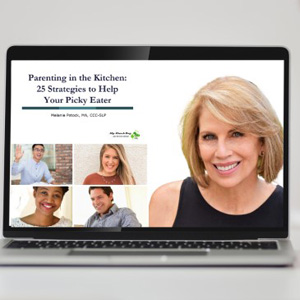
Melanie offers both on-demand courses and live-streaming Masterclasses. CEUs are optional for both OTs and SLPs, yet audience members include parents, RDs, pediatricians & other health care professionals.
Need help with a picky eater, or just want to prevent kids from falling into the chicken-nugget rut? As a parent, SLP or OT, what do you need to know about child nutrition? What about the anxious eater – Could this be more than just picky eating? Melanie’s on-demand course subscriptions provide the answers!
Want more in-depth instruction in a small group, virtual setting? Register for one of Melanie’s Masterclass!
Explore course options here.

Parenting Advice
Melanie’s advice has been shared in The New York Times, Washington Post, The Wall Street Journal, Parents Magazine and more. Over 150 articles for both parents and professionals are found here or contact Melanie for a personal one-hour coaching session via video chat.
Masterclass participants get a 25% discount on coaching.
Learn more about professional and parent coaching here.
Keynote Speaking
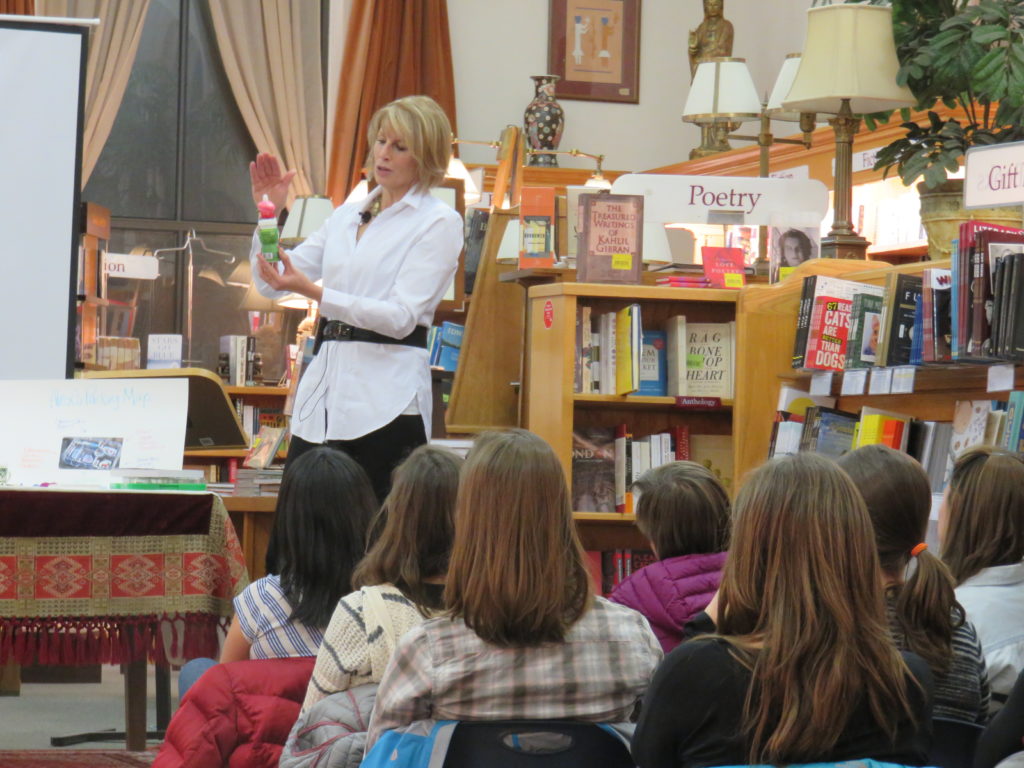
An international speaker, award-winning author and pediatric feeding specialist, audiences find Melanie’s advice to be practical and possible, even in the most challenging cases. That’s because Melanie is in the trenches, working closely with the most extreme picky eaters and supporting families and health professionals around the world. Melanie has been invited to speak at over 100 different events, including the American Speech Language Hearing Association’s National Conference and the Food and Nutrition Conference and Expo.
Audiences say it best: If you are looking for a professional speaker who can “provide practical solutions” for parents, caregivers and therapists and your company needs a “highly knowledgeable, organized presenter” with “energy and enthusiasm” who can deliver a “dynamic course”, then your best choice is Melanie Potock. Contact Melanie here.

Product Consulting
Need expert input on your new parenting product? Melanie has provided expert advice for Orgain, Inc., Holland Health Care, Inc., Healthy Height, Inc., NumNum, LLC and numerous health care and parent product companies.
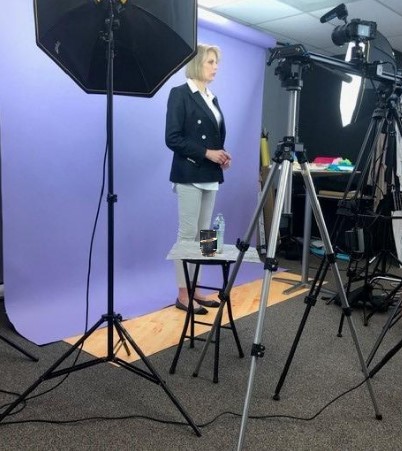
Looking for an expert to educate your team on how children learn to become adventurous eaters, baby-self feeding or the importance of purees? Feeding is developmental, just like learning to crawl, walk, run. At least 1 in 4 typically developing children have trouble learning to eat! Raising a healthy, happy eater requires the right tools and the right advice. Melanie provides company education and collaboration via webinars, social media and creating educational videos for your audience.
Contact Melanie here.